
Intelligent Production Planning, Predictive Maintenance, and Autonomous Factory Operations
The manufacturing industry is undergoing one of the most significant transformations since the Industrial Revolution. As customer expectations continue to evolve, global competition intensifies, and supply chains become increasingly unpredictable, manufacturers are under constant pressure to produce more, deliver faster, reduce costs, and maintain exceptional product quality.
Over the past two decades, factories have invested heavily in digital technologies such as Enterprise Resource Planning (ERP), Manufacturing Execution Systems (MES), Supervisory Control and Data Acquisition (SCADA), Programmable Logic Controllers (PLC), Industrial Internet of Things (IIoT) sensors, robotics, and automated production lines. These technologies have dramatically improved operational efficiency compared to traditional manufacturing environments.
However, despite these investments, many manufacturers continue to experience production delays, unexpected machine failures, quality issues, inventory shortages, excessive operational costs, and inefficient resource utilization.
The reason is surprisingly simple.
Modern factories have become highly digital—but they are not truly intelligent.
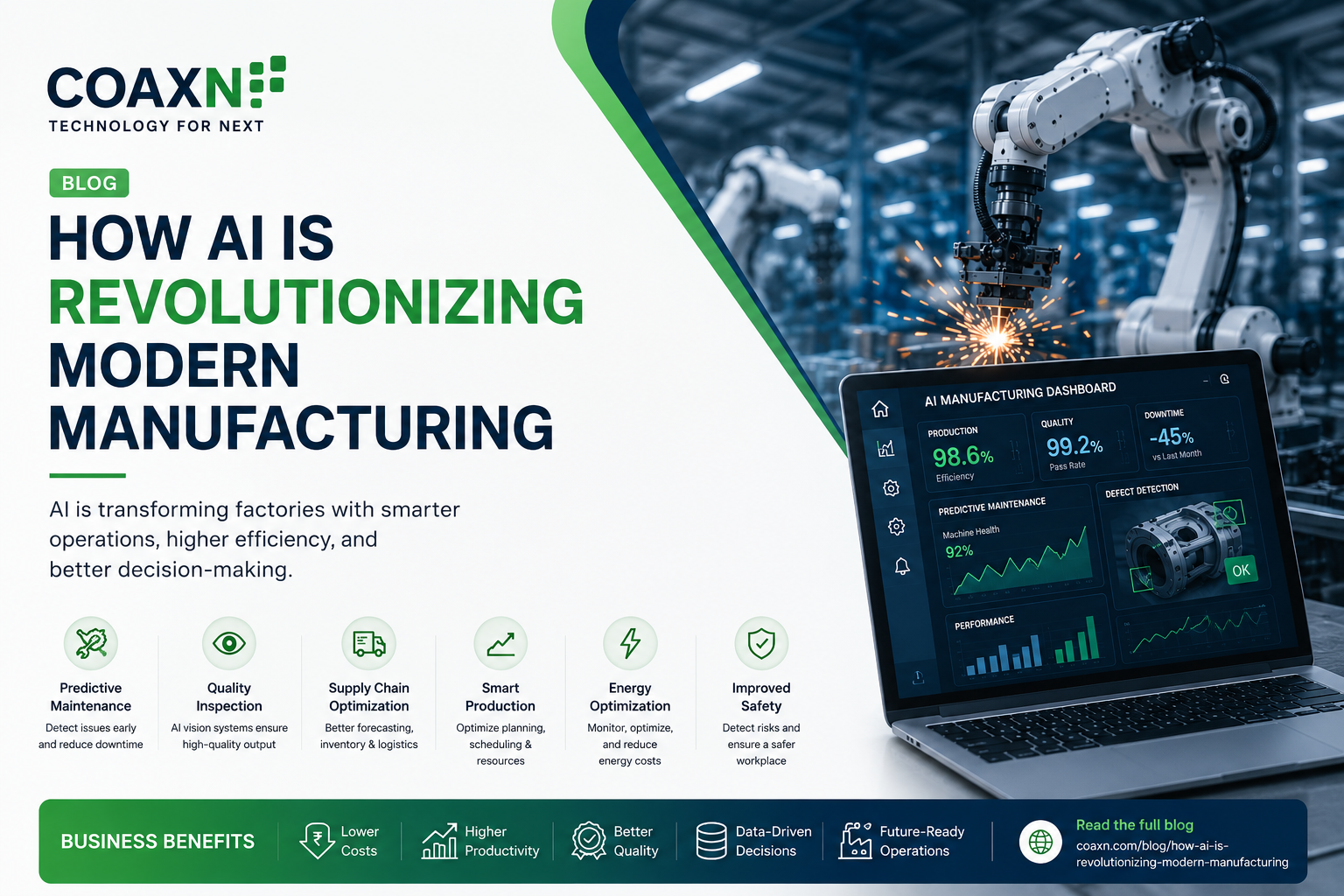
The Real Challenge Isn't Automation—It's Decision Making
Most manufacturing facilities today already possess enormous amounts of operational data.
- ERP systems manage customer orders and procurement.
- MES platforms monitor production execution.
- SCADA systems collect machine-level operational data.
- PLCs continuously control industrial equipment.
- IoT sensors generate real-time telemetry.
- Warehouse Management Systems track inventory movement.
- Quality Management Systems record inspection results.
- Maintenance platforms monitor equipment servicing schedules.
Every second, thousands of operational events are generated across these systems. Machine temperatures fluctuate. Inventory levels change. Production orders arrive. Quality inspections detect defects. Suppliers update delivery schedules. Maintenance teams replace components. Operators report abnormalities.
Individually, each system performs its intended function remarkably well.
Collectively, however, these systems rarely collaborate.
Instead of functioning as one intelligent manufacturing ecosystem, they operate as isolated information silos.
A Typical Manufacturing Scenario
Imagine an automotive component manufacturer producing brake assemblies for multiple global customers.
On Monday morning, the sales department receives an urgent purchase order requiring delivery within the next five days.
Immediately, the ERP system creates a production order and calculates the required materials.
The production planning team reviews available machine capacity and schedules Manufacturing Line 4 for production.
Everything appears to be perfectly planned.
Unfortunately, several critical facts remain hidden inside other systems.
- Machine vibration sensors indicate abnormal bearing wear.
- Maintenance software predicts an increasing probability of spindle failure.
- The warehouse has insufficient raw material because another production order has already reserved inventory.
- Quality inspection reports show increasing defect rates on products manufactured using the same machine.
- Energy monitoring systems predict unusually high electricity demand during the scheduled production window.
- A supplier has delayed shipment of a critical component.
None of these systems automatically communicate with the production planning process.
As a result, production begins based on incomplete information.
Several hours later, the primary CNC machine unexpectedly fails.
Production stops.
Operators remain idle.
Maintenance teams initiate emergency repairs.
Quality inspections identify defective products already manufactured before the breakdown.
Warehouse staff rush to source replacement materials.
Production planners completely rebuild the manufacturing schedule.
Customer delivery dates become uncertain.
Management schedules overtime shifts to recover lost production.
What initially appeared to be a simple machine failure quickly evolves into a company-wide operational disruption.
The Hidden Cost of Disconnected Manufacturing Systems
Most manufacturing challenges are not caused by a lack of automation. Instead, they result from disconnected decision-making across departments.
Every department optimizes its own objectives without understanding the broader operational impact.
| Department | Primary Focus | Missing Information |
|---|---|---|
| Sales | Customer delivery commitments | Machine capacity and maintenance status |
| Production Planning | Production schedules | Real-time machine health and inventory availability |
| Maintenance | Equipment reliability | Production priorities and delivery deadlines |
| Warehouse | Inventory management | Future production changes and customer demand |
| Quality | Product inspection | Machine condition and process optimization |
| Management | Business performance | Real-time operational intelligence |
Every department has valuable information.
None possesses the complete operational picture.
Why Traditional Manufacturing Software Is No Longer Enough
Many organizations assume implementing an ERP system or upgrading their MES platform will solve these operational challenges.
Unfortunately, software alone cannot solve problems that require continuous reasoning across multiple domains.
ERP systems excel at managing business transactions.
MES systems excel at monitoring production execution.
SCADA platforms excel at collecting machine data.
Maintenance software excels at scheduling equipment servicing.
Quality systems excel at recording inspection results.
Warehouse Management Systems excel at inventory control.
Each platform is optimized for a specific operational responsibility.
None of them continuously evaluates every operational variable simultaneously to answer questions such as:
- Should production continue if machine vibration exceeds acceptable thresholds?
- Would changing the production sequence reduce energy consumption?
- Should maintenance be performed immediately or after completing today's customer orders?
- Can another production line manufacture the same product with lower defect probability?
- Should procurement place additional purchase orders before supplier lead times increase?
- Can production schedules automatically adapt to unexpected customer demand?
- How will today's decisions affect tomorrow's production capacity?
Answering these questions requires continuous analysis across production planning, maintenance, quality, inventory, logistics, procurement, and machine operations.
Traditional enterprise software was never designed to perform this level of autonomous operational reasoning.
The Need for an Intelligent Decision Layer
Modern manufacturing does not require replacing existing ERP, MES, SCADA, PLC, or IoT investments.
Instead, manufacturers need an intelligent decision-making layer capable of connecting these systems, understanding their relationships, analyzing operational conditions in real time, and coordinating decisions across the entire factory.
Rather than acting as isolated software platforms, manufacturing systems must begin collaborating as a unified operational ecosystem.
This is where Artificial Intelligence moves beyond automation and becomes an operational partner capable of assisting production planners, maintenance engineers, quality inspectors, warehouse managers, and business executives simultaneously.
Instead of simply collecting data, AI transforms manufacturing data into actionable intelligence.
Rather than reacting to problems after they occur, intelligent manufacturing systems continuously predict, optimize, and coordinate factory operations before disruptions impact production.
The next generation of manufacturing is no longer defined by automated machines alone.
It is defined by intelligent systems capable of making coordinated decisions across the entire manufacturing enterprise.
From Connected Systems to Intelligent Factories: The Rise of AI-Driven Manufacturing
The previous generation of digital transformation focused on collecting data. Manufacturers invested in ERP platforms, Manufacturing Execution Systems (MES), SCADA, PLCs, IoT sensors, warehouse management systems, and quality management software to digitize business operations and production processes.
While these systems significantly improved visibility, they still depend heavily on human decision-making. Engineers analyze machine data, production planners manually adjust schedules, warehouse managers monitor inventory levels, and maintenance teams decide when equipment should be serviced.
In other words, the factory has become connected, but the decision-making process remains largely manual.
Artificial Intelligence changes this paradigm by transforming factories from data-driven organizations into intelligence-driven organizations.
Rather than replacing existing enterprise systems, AI becomes the operational intelligence layer that continuously analyzes information from every department, predicts future events, recommends optimal actions, and increasingly automates routine operational decisions.
AI as the Manufacturing Brain
Think of a modern manufacturing facility as the human body.
- Machines act as muscles that perform physical work.
- IoT sensors function as the nervous system, constantly collecting information from machines.
- ERP and MES systems serve as the memory, storing operational and business data.
- SCADA and PLCs provide real-time control over manufacturing equipment.
- Artificial Intelligence becomes the brain that interprets information, reasons about operational conditions, predicts future outcomes, and coordinates decisions across the entire factory.
Instead of reacting after problems occur, AI continuously evaluates thousands of operational variables every second and determines the best course of action based on current production priorities.
Introducing Multi-Agent AI in Manufacturing
As manufacturing operations become increasingly complex, relying on a single AI model to manage every aspect of production is neither practical nor scalable.
Modern intelligent factories are beginning to adopt Multi-Agent AI Systems, where multiple specialized AI agents collaborate to achieve common operational goals.
Each AI agent acts as a digital expert responsible for a specific manufacturing domain while continuously communicating with other agents across the factory.
Instead of one large AI attempting to understand everything, multiple intelligent agents work together exactly as human departments collaborate inside an organization.
The Manufacturing AI Workforce
1. Production Planning Agent
The Production Planning Agent continuously analyzes incoming customer orders, production capacity, workforce availability, machine utilization, and delivery commitments.
Instead of producing static schedules once every morning, the AI dynamically adjusts production plans throughout the day whenever operational conditions change.
For example, if a high-priority customer order arrives unexpectedly, the agent automatically evaluates machine availability, production impact, delivery deadlines, and resource allocation before recommending an optimized production schedule.
2. Inventory Optimization Agent
Raw materials represent one of the largest investments in manufacturing operations.
Maintaining excessive inventory increases storage costs and ties up working capital, while insufficient inventory can stop production entirely.
The Inventory Optimization Agent continuously monitors inventory consumption, supplier lead times, demand forecasts, procurement schedules, and production plans.
Rather than waiting until stock levels become critical, AI predicts future inventory requirements and recommends purchase orders before shortages occur.
The result is lower inventory costs without increasing production risk.
3. Machine Health Monitoring Agent
Modern industrial equipment continuously generates operational data through vibration sensors, temperature probes, current sensors, pressure sensors, oil quality sensors, and acoustic monitoring devices.
Human engineers cannot realistically monitor thousands of sensor readings across hundreds of machines simultaneously.
The Machine Health Monitoring Agent continuously evaluates sensor data in real time and establishes a baseline for normal machine behavior.
Whenever unusual operating conditions appear, the AI immediately detects anomalies that may indicate developing mechanical or electrical failures.
Instead of simply generating alarms after failures occur, the system identifies subtle patterns that humans might overlook.
4. Predictive Maintenance Agent
Once abnormal machine behavior has been detected, the Predictive Maintenance Agent evaluates the likelihood of equipment failure.
Rather than servicing equipment according to fixed maintenance intervals, AI estimates the remaining useful life of critical components using historical maintenance records, machine operating conditions, environmental factors, and sensor data.
Maintenance activities are scheduled when they provide the greatest operational benefit rather than according to rigid maintenance calendars.
Emergency breakdowns gradually become planned maintenance activities.
5. Computer Vision Quality Inspection Agent
Traditional quality inspection often depends on manual visual inspection or random sampling.
Both approaches are vulnerable to human fatigue and inconsistent inspection quality.
Computer Vision systems equipped with deep learning models inspect every manufactured product in real time.
High-resolution industrial cameras capture images immediately after production.
AI identifies scratches, dimensional deviations, missing components, surface defects, incorrect labels, assembly errors, welding defects, and cosmetic imperfections within milliseconds.
Instead of discovering quality issues at the end of production, defective products are detected immediately, reducing scrap, rework, warranty claims, and customer complaints.
6. Energy Optimization Agent
Energy costs continue to represent a significant portion of manufacturing operating expenses.
The Energy Optimization Agent continuously monitors electricity consumption, compressed air systems, machine idle time, HVAC operations, production schedules, and peak demand periods.
By coordinating production schedules with energy availability and machine utilization, AI minimizes unnecessary power consumption while maintaining production efficiency.
7. Digital Twin Agent
One of the most powerful capabilities introduced by AI is the Digital Twin.
A Digital Twin is a continuously updated virtual representation of the physical factory.
Every production line, machine, inventory location, material movement, operator assignment, and operational process is mirrored digitally.
This virtual factory enables manufacturers to simulate production changes before implementing them in the real world.
Managers can evaluate scenarios such as increasing production capacity, introducing new product lines, changing machine layouts, or responding to unexpected customer demand without disrupting live manufacturing operations.
The Factory Supervisor AI
Although each AI agent specializes in a particular operational domain, manufacturing decisions rarely belong to a single department.
The true strength of Multi-Agent AI lies in collaboration.
A supervisory AI continuously coordinates communication between all specialized agents.
For example, when the Machine Health Agent detects abnormal spindle vibration, the Factory Supervisor immediately requests recommendations from multiple agents:
- The Maintenance Agent estimates remaining useful life.
- The Production Planning Agent evaluates schedule changes.
- The Inventory Agent verifies material availability.
- The Quality Agent assesses defect risk.
- The Energy Agent evaluates production alternatives.
Instead of each department making isolated decisions, the factory responds as one intelligent ecosystem.
Within seconds, production schedules are adjusted, maintenance windows are optimized, inventory reservations are updated, and management receives a complete explanation of every recommended action.
This collaborative intelligence represents one of the most significant advancements in manufacturing since the introduction of industrial automation.
From Reactive Manufacturing to Autonomous Operations
Traditional manufacturing focuses on reacting to events after they occur.
AI-powered manufacturing continuously predicts future events, evaluates operational risks, and recommends the optimal course of action before disruptions impact production.
Instead of asking, "What happened?", modern manufacturers begin asking, "What is likely to happen next, and what should we do now?"
This shift from reactive operations to predictive and increasingly autonomous decision-making is what defines the next generation of smart manufacturing.
A Day Inside an AI-Powered Smart Factory
To better understand how Artificial Intelligence transforms manufacturing operations, let's walk through the lifecycle of a real production order inside a modern AI-enabled factory.
Imagine an automotive manufacturer that produces brake discs for multiple global automobile brands. The factory operates 24 hours a day with automated CNC machines, robotic assembly stations, automated warehouses, conveyor systems, industrial cameras, PLC-controlled equipment, and hundreds of IoT sensors monitoring every critical asset.
Unlike traditional factories where each department works independently, every operational decision inside this factory is continuously coordinated by a Multi-Agent AI platform.
Step 1: Customer Places an Order
At 9:00 AM, a customer places an urgent order for 20,000 brake discs that must be delivered within seven days.
The ERP system immediately records the sales order, verifies customer information, delivery location, contractual pricing, and requested shipment date.
Traditionally, this is where production planners begin manually reviewing machine availability, inventory, workforce schedules, and production capacity.
In an AI-powered factory, this process is almost entirely autonomous.
The Production Planning Agent immediately receives the new order and begins evaluating every operational variable across the factory.
- Current production schedules
- Machine utilization
- Available operators
- Material availability
- Tool availability
- Customer priorities
- Expected delivery commitments
- Historical production performance
Within seconds, AI generates multiple optimized production plans instead of a single fixed schedule.
Step 2: AI Verifies Inventory Before Production Begins
Before approving the production schedule, the Inventory Optimization Agent verifies whether sufficient raw materials are available.
Instead of checking only current warehouse stock, AI evaluates future inventory requirements across every active production order.
It discovers that steel inventory is technically available today but will become insufficient after tomorrow because another high-priority customer order requires the same material.
Rather than waiting until production stops, the AI automatically recommends placing an additional purchase order with the preferred supplier while simultaneously identifying an alternative supplier in case delivery delays occur.
Warehouse managers receive the recommendation immediately, allowing procurement to act before inventory shortages affect production.
Step 3: AI Evaluates Machine Health
With inventory confirmed, the Machine Health Monitoring Agent begins evaluating the condition of every machine scheduled for production.
Hundreds of IoT sensors continuously transmit operational information, including:
- Spindle vibration
- Motor temperature
- Hydraulic pressure
- Electrical current
- Lubrication quality
- Bearing noise
- Machine cycle time
- Tool wear measurements
Although every measurement remains within acceptable operating limits, AI identifies a gradual increase in vibration on CNC Machine 12 over the past several weeks.
Human operators may not notice this subtle trend because the machine continues operating normally.
The AI detects that the vibration pattern closely resembles historical failures recorded on similar machines.
Step 4: Predictive Maintenance Prevents Production Downtime
Once the abnormal vibration pattern has been detected, the Predictive Maintenance Agent performs a deeper analysis.
Using historical maintenance records, sensor data, machine operating conditions, environmental factors, and equipment usage history, AI estimates that the spindle bearing has approximately 120 operating hours remaining before failure becomes highly probable.
Instead of shutting down production immediately, the AI evaluates the production schedule and identifies a maintenance window after the current customer order is completed.
Maintenance engineers automatically receive:
- Predicted failure probability
- Remaining useful life estimate
- Recommended replacement parts
- Estimated maintenance duration
- Optimal maintenance schedule
The replacement bearing is ordered automatically, ensuring it arrives before maintenance begins.
A costly unplanned machine breakdown has now become a scheduled maintenance activity with minimal impact on production.
Step 5: Intelligent Production Begins
Production starts according to the optimized schedule generated by the Production Planning Agent.
Throughout manufacturing, AI continuously monitors:
- Production throughput
- Machine utilization
- Cycle time
- Operator productivity
- Tool wear
- Material consumption
- Production bottlenecks
- Queue lengths
If one production line begins falling behind schedule, AI immediately evaluates whether another production line has available capacity.
Rather than waiting for supervisors to intervene, production is automatically rebalanced across available resources while ensuring customer delivery commitments remain unchanged.
Step 6: Every Product Is Inspected by AI
As each brake disc leaves the CNC machine, it passes through an automated Computer Vision inspection station.
High-resolution industrial cameras capture multiple images of every product from different angles.
Deep learning models immediately inspect each component for:
- Surface scratches
- Cracks
- Incorrect dimensions
- Machining defects
- Surface finish quality
- Missing holes
- Improper engraving
- Foreign particles
Unlike manual inspection, AI evaluates every single manufactured component instead of random samples.
If the defect rate suddenly increases, the Quality Inspection Agent immediately communicates with both the Machine Health Agent and Production Planning Agent.
Together they determine whether production should continue, reduce machine speed, change tooling, or temporarily stop the production line.
Quality problems are therefore resolved at their source instead of being discovered after thousands of defective products have already been manufactured.
Step 7: AI Optimizes Factory Energy Consumption
During production, the Energy Optimization Agent continuously monitors electricity usage across the entire manufacturing facility.
Rather than allowing all energy-intensive machines to operate simultaneously, AI intelligently distributes workloads to reduce peak electricity demand.
Idle machines are automatically placed into low-power operating modes.
Compressed air systems, HVAC equipment, industrial chillers, and lighting systems are adjusted dynamically according to production requirements.
This not only lowers operating costs but also helps manufacturers achieve sustainability and carbon reduction objectives.
Step 8: The Digital Twin Simulates the Future
Every operational event occurring inside the physical factory is simultaneously reflected inside a Digital Twin—a virtual representation of the manufacturing environment.
Managers can observe production progress in real time while simulating future scenarios without affecting live operations.
For example, management may ask:
- Can production increase by 30% next month?
- What happens if Machine 12 is unavailable for two days?
- Can a second production shift reduce delivery times?
- Will a new production line eliminate current bottlenecks?
The Digital Twin evaluates these scenarios using current production data and predicts operational outcomes before any physical changes are made.
This dramatically reduces investment risk while improving strategic planning.
Step 9: Factory Intelligence Dashboard
Throughout the entire manufacturing process, every AI agent continuously shares operational insights with the Factory Supervisor AI.
Instead of reviewing disconnected reports from multiple software systems, plant managers receive a unified operational dashboard showing the overall health of the factory.
Executives can monitor:
- Production progress
- Machine health scores
- Inventory availability
- Maintenance schedules
- Quality performance
- Energy consumption
- Delivery commitments
- Overall Equipment Effectiveness (OEE)
Most importantly, AI not only reports what is happening but also explains why it is happening and recommends the next best action.
The Result: A Self-Optimizing Manufacturing Ecosystem
By integrating Production Planning, Inventory Optimization, Machine Health Monitoring, Predictive Maintenance, Computer Vision Quality Inspection, Energy Optimization, and Digital Twin technologies into a collaborative Multi-Agent AI platform, manufacturers move beyond simple automation toward autonomous operations.
The factory no longer reacts to disruptions after they occur. Instead, it continuously predicts, plans, coordinates, and optimizes every stage of production in real time.
The result is higher productivity, improved product quality, reduced downtime, optimized inventory, lower operating costs, increased sustainability, and a manufacturing operation capable of adapting dynamically to changing customer demands.
Behind the Scenes: The AI Technologies Powering the Smart Factory
Building an intelligent manufacturing ecosystem requires much more than deploying a Large Language Model (LLM). Modern AI-powered factories combine multiple specialized Artificial Intelligence models, each designed to solve a specific operational challenge.
Just as a manufacturing plant consists of multiple departments working together, an AI-driven factory consists of multiple machine learning models, computer vision systems, optimization algorithms, and intelligent agents collaborating continuously.
Each AI model contributes unique capabilities while sharing information with other models through a centralized AI orchestration platform.
1. Large Language Models (LLMs) — The Manufacturing Intelligence Layer
Large Language Models such as GPT, Llama, Mistral, Claude, or enterprise fine-tuned language models act as the reasoning engine of the factory.
Unlike traditional software that follows predefined business rules, LLMs understand natural language, analyze operational context, summarize information, generate recommendations, and coordinate communication between specialized AI agents.
In manufacturing, LLMs can:
- Generate production planning recommendations
- Explain machine failures in plain language
- Create maintenance reports automatically
- Summarize production KPIs
- Answer operator questions using internal documentation
- Assist engineers through conversational interfaces
- Coordinate multiple AI agents
- Generate executive dashboards and operational summaries
Rather than replacing engineers, LLMs reduce the time required to interpret complex operational data and transform technical insights into actionable business decisions.
2. Time-Series Machine Learning Models
Manufacturing equipment continuously generates sensor readings that change over time.
Analyzing these sequential data streams requires specialized time-series forecasting models.
These models learn historical operating behavior and predict future machine conditions before failures occur.
Common applications include:
- Predictive maintenance
- Remaining Useful Life (RUL) estimation
- Energy demand forecasting
- Production throughput prediction
- Machine anomaly detection
- Equipment utilization forecasting
Typical algorithms include:
- LSTM (Long Short-Term Memory Networks)
- GRU (Gated Recurrent Units)
- Temporal Convolutional Networks (TCN)
- Transformer-based Time-Series Models
- XGBoost
- LightGBM
- Random Forest Regression
3. Computer Vision Models
Quality inspection is one of the most mature AI applications in manufacturing.
Industrial cameras combined with deep learning models inspect products faster and more consistently than manual inspection methods.
Instead of checking random samples, AI inspects every manufactured component in real time.
Common Computer Vision tasks include:
- Surface defect detection
- Scratch detection
- Crack identification
- Missing component detection
- Dimension verification
- OCR for labels and serial numbers
- Barcode and QR code validation
- Assembly verification
Popular deep learning architectures include:
- YOLO (You Only Look Once)
- Faster R-CNN
- Mask R-CNN
- EfficientNet
- Vision Transformers (ViT)
- ResNet
- U-Net
- SAM (Segment Anything Model)
4. Predictive Analytics Models
Predictive Analytics helps manufacturers anticipate future business events before they occur.
These models combine production history, maintenance records, customer demand, supplier performance, machine utilization, and environmental conditions to estimate future outcomes.
Typical predictions include:
- Production delays
- Equipment failure probability
- Supplier delivery risks
- Inventory shortages
- Demand forecasting
- Quality defect probability
5. Optimization Algorithms
Manufacturing rarely has one perfect solution.
AI must evaluate thousands of possible production schedules while balancing competing objectives.
Optimization algorithms determine the best possible decision under multiple operational constraints.
Examples include:
- Production scheduling
- Machine allocation
- Operator assignment
- Vehicle routing
- Warehouse optimization
- Supply chain optimization
- Energy scheduling
Common optimization techniques include:
- Linear Programming
- Mixed Integer Programming
- Constraint Optimization
- Genetic Algorithms
- Particle Swarm Optimization
- Reinforcement Learning
6. Retrieval-Augmented Generation (RAG)
Manufacturing organizations possess enormous volumes of engineering documentation, SOPs, maintenance manuals, PLC documentation, quality procedures, and machine specifications.
Instead of relying solely on information learned during model training, Retrieval-Augmented Generation (RAG) allows AI systems to retrieve relevant enterprise knowledge before generating responses.
This enables operators to ask questions such as:
- How do I replace the spindle bearing on Machine 12?
- What caused the last similar machine failure?
- Show the maintenance procedure for this equipment.
- Which supplier previously delivered this spare part?
The AI responds using the organization's own documentation, making recommendations both context-aware and organization-specific.
Edge AI vs Cloud AI
| Edge AI | Cloud AI |
|---|---|
| Runs directly on factory devices | Runs in cloud infrastructure |
| Low latency | High computing power |
| Supports real-time inspection | Supports enterprise analytics |
| Works without internet connectivity | Requires network connectivity |
| Ideal for machine control | Ideal for strategic planning |
Most modern manufacturers adopt a hybrid architecture where Computer Vision and machine monitoring operate at the edge while enterprise AI agents execute within secure cloud infrastructure.
A Reference Enterprise AI Architecture
Industrial Machines
        │
        ▼
 PLC • SCADA • IoT Sensors
        │
        ▼
 Manufacturing Execution System (MES)
        │
        ▼
 Enterprise Resource Planning (ERP)
        │
        ▼
 Data Lake / Streaming Platform
        │
        ▼
AI Platform
 ├── Production Planning Agent
 ├── Inventory Agent
 ├── Machine Health Agent
 ├── Predictive Maintenance Agent
 ├── Computer Vision Agent
 ├── Energy Optimization Agent
 ├── Digital Twin Engine
 └── Factory Supervisor Agent
        │
        ▼
Factory Dashboard
Mobile Apps
Executive Reports
Alerts
APIs
The Business Impact
Organizations implementing AI across production planning, maintenance, quality, inventory, and factory operations typically achieve measurable improvements across multiple business functions.
| KPI | Traditional Factory | AI-Powered Factory |
|---|---|---|
| Production Planning | Several hours | Minutes |
| Machine Downtime | Reactive | Predictive |
| Quality Inspection | Sampling | 100% Inspection |
| Inventory Planning | Manual | AI Forecasting |
| Energy Management | Reactive | Continuous Optimization |
| Decision Making | Human Driven | AI Assisted |
Conclusion
Artificial Intelligence is no longer a standalone technology deployed to solve isolated manufacturing problems. It is becoming the intelligence layer that connects production planning, machine health monitoring, predictive maintenance, quality inspection, inventory optimization, energy management, and digital twins into a unified operational ecosystem.
The future factory will not be defined by fully autonomous machines operating without human involvement. Instead, it will be characterized by seamless collaboration between skilled engineers and intelligent AI systems. While AI continuously analyzes millions of operational signals, predicts disruptions, and recommends optimal actions, human experts remain responsible for strategic decisions, innovation, and continuous improvement.
Manufacturers that embrace this collaborative approach today will be better positioned to reduce costs, improve product quality, optimize resources, and respond quickly to changing market demands. As Industry 4.0 evolves toward Industry 5.0, competitive advantage will increasingly belong to organizations that transform data into intelligence and intelligence into better operational decisions.
The journey toward autonomous manufacturing has already begun. The question is no longer whether AI will become part of the factory—it is how quickly manufacturers can integrate intelligent systems into their operations and unlock the full potential of connected, data-driven production.