Introduction
Large Language Models (LLMs) have evolved from simple chatbots into intelligent systems capable of planning, reasoning, coding, researching, and automating complex business workflows. However, building production-ready AI applications requires much more than a single AI model.
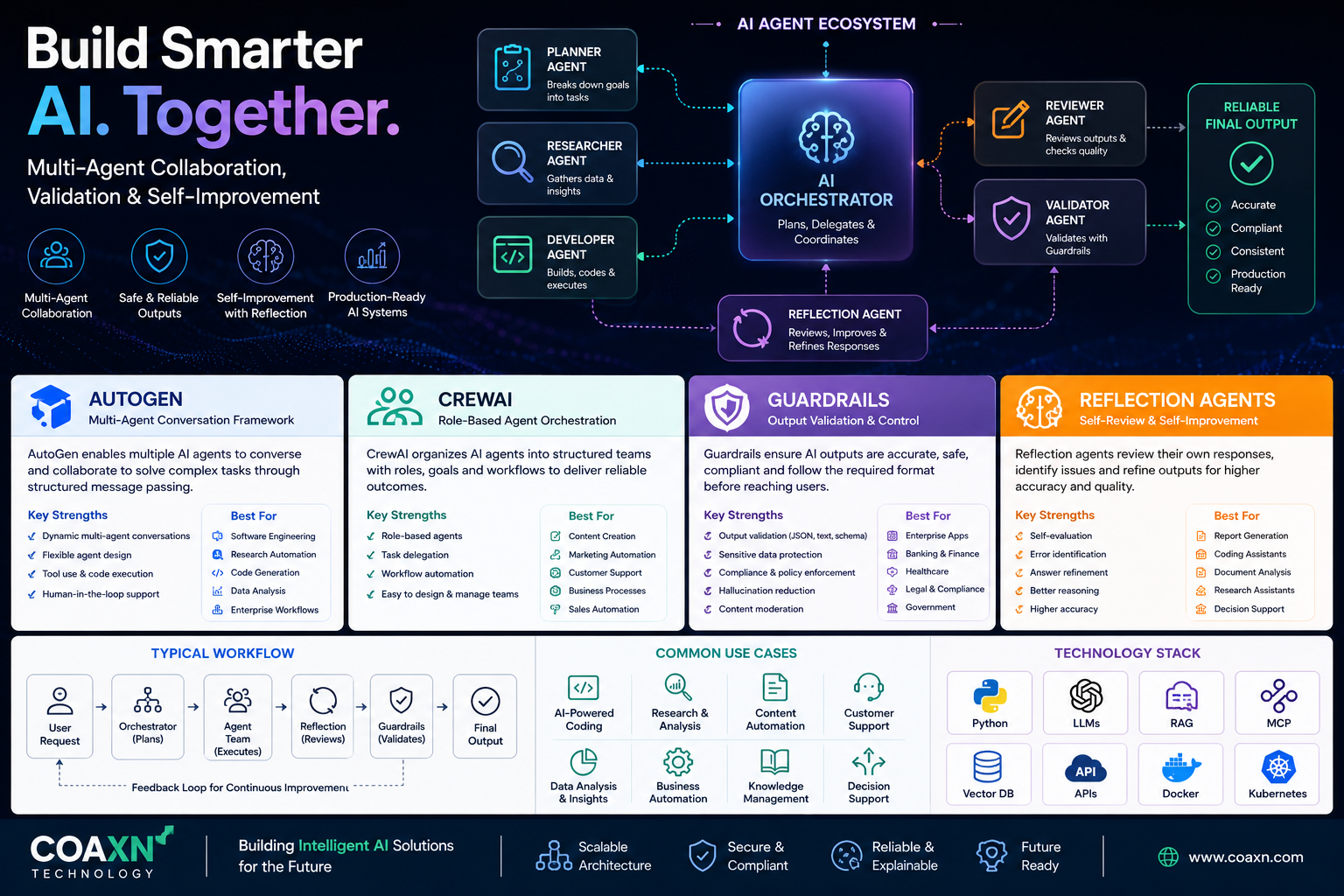
Modern AI systems combine multiple specialized agents, orchestration frameworks, validation mechanisms, and self-improving workflows to deliver accurate and reliable results. Frameworks like AutoGen, CrewAI, Guardrails, and Reflection Agents each solve different challenges in this ecosystem.
In this article, we'll explore how these technologies work, where they fit, and how they can be combined to build enterprise-grade AI solutions.
The Evolution of AI Agents
Early AI applications relied on a single prompt and a single response. Today's enterprise AI applications require multiple specialized agents collaborating to solve complex tasks while ensuring the final output is accurate, secure, and compliant.
Traditional AI
User → LLM → Response

Modern AI
User → Orchestrator → Multiple AI Agents → Validation → Final Response
What is AutoGen?
AutoGen is Microsoft's open-source framework for building collaborative multi-agent AI systems. Instead of relying on one AI assistant, AutoGen allows multiple intelligent agents to communicate with one another to solve complex problems.
Typical AutoGen Agents
- Planner Agent
- Research Agent
- Developer Agent
- Reviewer Agent
- Executor Agent
Each agent has a specific responsibility and collaborates through structured conversations until the task is completed.
Ideal Use Cases
- Software development assistants
- Research automation
- Data analysis
- Enterprise workflow automation
- AI-powered coding platforms
What is CrewAI?
CrewAI focuses on role-based collaboration. It organizes AI agents into a structured team where each member performs a well-defined responsibility within a workflow.
Instead of free-form conversations, CrewAI follows organized task delegation similar to how human teams operate.
Example Crew Structure
| Agent | Responsibility |
|---|---|
| Manager | Assign tasks |
| Researcher | Collect information |
| Writer | Create content |
| Reviewer | Verify quality |
| QA Agent | Final validation |
Best Use Cases
- Content generation
- Marketing automation
- Customer support
- Business workflow automation
- Knowledge management
What are Guardrails?
One of the biggest challenges with AI is ensuring responses are accurate, secure, and consistent. Guardrails provide validation mechanisms that improve AI reliability before responses reach users.
Rather than generating content, Guardrails verify and control AI outputs.
Guardrails Can Validate
- JSON structure
- Required fields
- Output formatting
- Compliance rules
- Sensitive information
- Business policies
- Hallucination detection
- Content moderation
Guardrails are especially important for enterprise applications where incorrect responses can impact business operations.
What is a Reflection Agent?
A Reflection Agent improves answer quality by reviewing its own output before producing the final response.
Instead of immediately returning an answer, it performs a second reasoning step to identify mistakes, improve clarity, and verify accuracy.
Draft Response
      ↓
Self Review
      ↓
Identify Issues
      ↓
Improve Response
      ↓
Final Answer
Benefits of Reflection
- Better reasoning
- Reduced hallucinations
- Higher accuracy
- Improved consistency
- Higher quality responses
How They Work Together
These technologies are not competitors. They complement one another to create intelligent, reliable AI systems.
User Request
      │
      ▼
Orchestrator
      │
      ▼
Planner Agent
      │
      ▼
Research Agent
      │
      ▼
Developer / Writer Agent
      │
      ▼
Reflection Agent
      │
      ▼
Guardrails Validation
      │
      ▼
Final Response
This layered approach significantly improves reliability, scalability, and enterprise readiness.
Feature Comparison
| Feature | AutoGen | CrewAI | Guardrails | Reflection |
|---|---|---|---|---|
| Multi-Agent Collaboration | ✔ | ✔ | ✖ | ✖ |
| Role-Based Workflow | Partial | ✔ | ✖ | ✖ |
| Output Validation | ✖ | ✖ | ✔ | Partial |
| Self Review | ✖ | ✖ | ✖ | ✔ |
| Enterprise Ready | High | High | Very High | High |
Real-World Enterprise Example
Imagine building an AI assistant for a logistics company.
- The Planner Agent understands the customer's request.
- The Research Agent retrieves shipment and inventory information.
- The Analytics Agent predicts delivery delays.
- The Writer Agent prepares the response.
- The Reflection Agent reviews the answer.
- Guardrails verify formatting, compliance, and required fields.
- The customer receives an accurate and validated response.
This architecture delivers significantly higher reliability than relying on a single AI model.
Which Framework Should You Choose?
| If You Need... | Recommended Solution |
|---|---|
| Collaborative AI Agents | AutoGen |
| Role-Based Business Automation | CrewAI |
| Reliable & Safe AI Output | Guardrails |
| High-Accuracy AI Responses | Reflection Agents |
| Enterprise AI Platform | Combine All Four |
How CoAxn Technology Can Help
At CoAxn Technology, we design enterprise AI platforms that combine multi-agent orchestration, Retrieval-Augmented Generation (RAG), workflow automation, validation pipelines, and modern AI architectures.
Whether you're building an AI customer support platform, enterprise knowledge assistant, coding assistant, compliance solution, or business automation system, our team helps organizations develop scalable, secure, and production-ready AI applications.
Conclusion
The future of AI is not about a single intelligent assistant—it is about intelligent teams of specialized agents working together. AutoGen enables collaboration, CrewAI organizes structured workflows, Guardrails ensure reliability, and Reflection Agents improve reasoning and accuracy.
By combining these technologies, businesses can build AI systems that are more reliable, explainable, and capable of solving complex real-world challenges at enterprise scale.