
Introduction: The Evolution from Medical Chatbots to AI Agent Systems
Artificial intelligence is changing how healthcare organizations process information, support clinical workflows, and analyze patient records. From medical document processing to clinical data analysis, AI is creating new opportunities to improve healthcare operations.
However, building a genuinely useful medical AI system involves much more than connecting a chatbot to a language model. Healthcare data is complex and often comes from multiple sources, including PDFs, Excel spreadsheets, electronic health records, laboratory reports, medical images, and structured databases.
Before an AI model can generate meaningful insights, information must be collected, validated, protected, interpreted, and prepared. This is where multi-agent AI architecture becomes valuable.
Instead of asking one AI model to perform every task, developers can build a coordinated system consisting of specialized agents. Each agent handles a specific responsibility and passes validated results to the next stage.
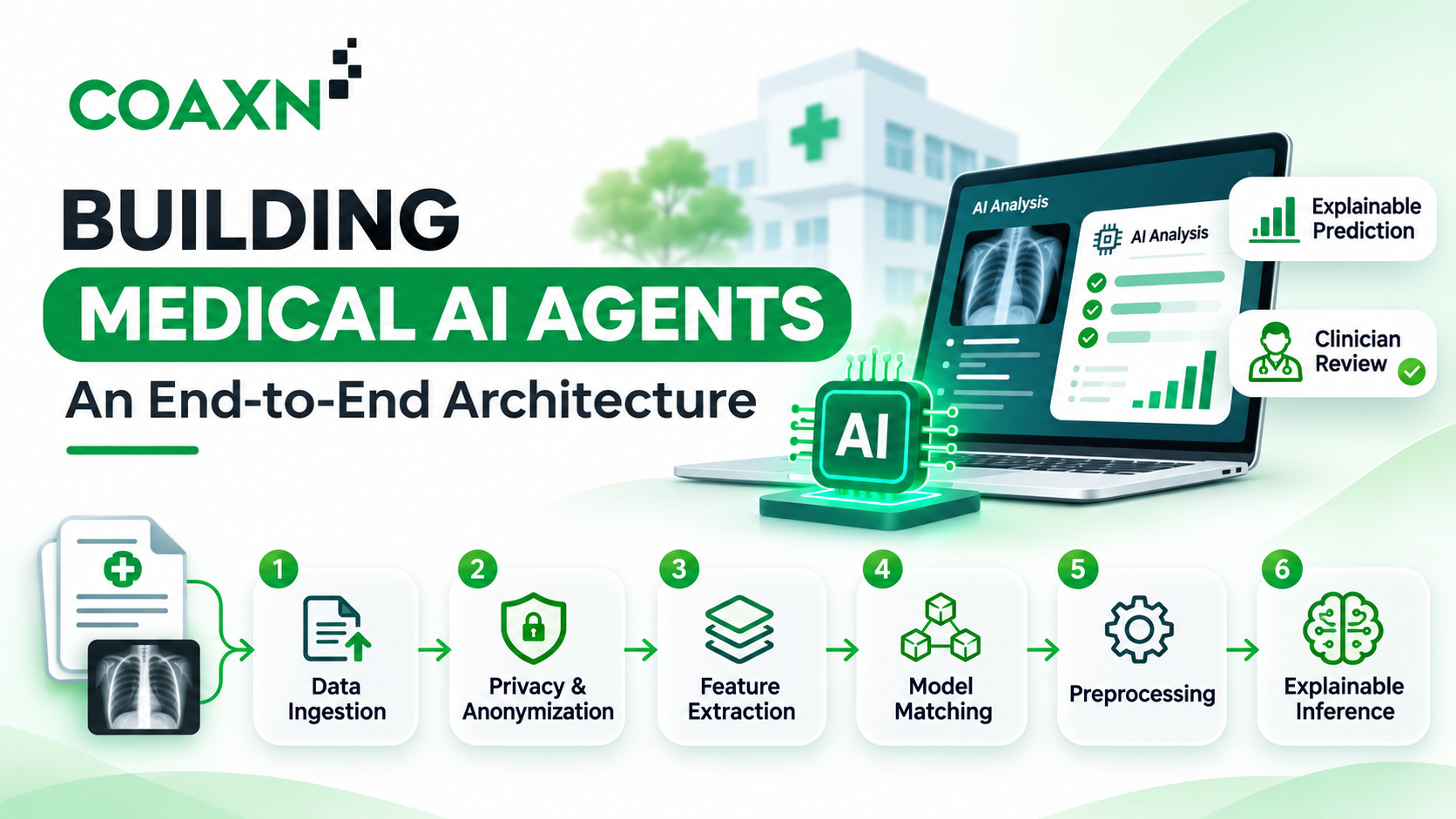
In this article, we explore a practical six-agent architecture for building medical AI systems, from raw patient data ingestion to explainable predictions.
1. Understanding the End-to-End Medical AI Architecture
A production-oriented medical AI system can be divided into six major stages:
- Data ingestion and identification
- Privacy protection and anonymization
- Medical data reading and feature extraction
- Model and data matching
- Data preprocessing and preparation
- Model inference and explainability
Each stage has a dedicated agent, supported by conventional software services, databases, validation rules, and machine learning models.
The Complete Workflow
Raw Patient Data → Data Ingestion → Privacy Protection → Feature Extraction → Model Matching → Data Preparation → Prediction and Explanation → Clinician Review
The objective is to transform unstructured and structured healthcare information into reliable, traceable, and useful clinical insights.
An important design principle is that agents should not operate without boundaries. Each agent should have clearly defined inputs, outputs, permissions, and validation rules.
2. Agent 1: Build the Data Ingestion and Identifier Agent
The first agent is responsible for receiving healthcare information from different sources and identifying what type of data has arrived.
Healthcare organizations rarely maintain all their information in one format. A hospital may receive patient registration documents, laboratory reports in PDF format, clinical notes in Word documents, patient records in Excel spreadsheets, medical images such as X-rays and MRI scans, and structured records from hospital management systems.
What Does the Ingestion Agent Do?
A. Read Multiple File Formats
The agent identifies and routes incoming files to appropriate processing services.
| File Type | Processing Approach |
|---|---|
| Text extraction and OCR | |
| Excel / CSV | Tabular data extraction |
| JSON | Structured data parsing |
| ZIP | Secure extraction and file classification |
| DICOM | Medical imaging metadata and image processing |
| Word documents | Text and table extraction |
| API data | Schema validation and normalization |
The agent should not assume that every file is valid simply because it has a recognizable extension. It should validate file signatures, size limits, schemas, and content before processing.
B. Identify the Document Type
The system can classify documents into categories such as:
- Patient history
- Laboratory report
- Prescription
- Radiology report
- Discharge summary
- Clinical assessment
Classification can combine deterministic rules, document metadata, OCR, and AI-based document understanding.
C. Route Data to the Correct Workflow
For example, a blood test report can be routed to laboratory data extraction, an X-ray to the medical imaging workflow, and a patient history document to clinical text processing.
Example
Imagine a hospital uploading 500 laboratory reports in PDF format. The ingestion agent can:
- Detect the uploaded files.
- Validate the file formats.
- Extract document metadata.
- Classify each report.
- Create processing jobs.
- Send each document to the appropriate extraction service.
- Record processing status and errors.
Expected Result: Healthcare data enters the platform through a standardized and traceable ingestion process.
3. Agent 2: Build the Privacy Guard and Data Anonymization Agent
Patient privacy must be considered from the beginning of a medical AI project, not added as a final security feature.
Healthcare documents frequently contain personally identifiable information (PII) and protected health information (PHI), including:
- Patient names
- Phone numbers and email addresses
- Home addresses
- Medical record numbers
- Dates of birth
- Insurance identifiers
- Other information that can identify an individual
An AI workflow should only access the patient information required for its assigned task.
What Does the Privacy Agent Do?
A. Detect Sensitive Information
The agent scans incoming text and extracted document content to identify sensitive fields.
Original Record:
- Patient Name: John Smith
- Date of Birth: 12/05/1985
- Patient ID: PT-10245
- Diagnosis: Type 2 Diabetes
- HbA1c: 8.2%
After Pseudonymization:
- Patient Reference: PAT-00001
- Date of Birth: Restricted or generalized according to the use case
- Diagnosis: Type 2 Diabetes
- HbA1c: 8.2%
The clinical information may remain available for an authorized analytical workflow while direct identifiers are removed or replaced where appropriate.
B. Apply Anonymization or Pseudonymization
These terms are not interchangeable:
- Anonymization: Data is transformed so individuals cannot reasonably be identified, considering the applicable context and re-identification risks.
- Pseudonymization: Direct identifiers are replaced with artificial identifiers, while additional information may still allow authorized re-identification.
A mapping between the original patient identity and pseudonymous reference should be stored separately with strict access controls.
C. Protect Medical Images
Medical images can contain patient information in DICOM metadata and, in some cases, text embedded directly into image pixels. Privacy processing must consider both metadata and image content.
D. Enforce Access Permissions
The agent should work with an authorization service that determines which users, agents, and external services can access specific information.
Expected Result: Sensitive patient information is protected before data moves into downstream AI workflows.
For US healthcare environments, the HIPAA Security Rule requires appropriate administrative, physical, and technical safeguards to protect electronic protected health information. These include access controls, audit controls, authentication, and transmission security.
Read the HHS HIPAA Security Rule guidance.
4. Agent 3: Build the Medical Data Reader and Feature Extraction Agent
Once the data is ingested and privacy controls are applied, the next challenge is understanding what the information actually contains.
A medical report may contain hundreds of fields, but only a subset may be relevant to a particular AI use case.
For example, a diabetes risk assessment may require information such as:
- Patient age
- Relevant medical history
- HbA1c
- Blood glucose
- BMI
- Blood pressure
- Medication history
- Other clinically relevant variables
The data reader agent converts raw information into structured clinical features.
What Does the Agent Do?
A. Extract Structured Information from Tables
Consider a laboratory report:
| Test | Result | Unit | Reference Range |
|---|---|---|---|
| HbA1c | 8.2 | % | Lab-specific |
| Fasting glucose | 145 | mg/dL | Lab-specific |
| Total cholesterol | 210 | mg/dL | Lab-specific |
The agent identifies the test name, value, unit, reference range, and other available metadata.
B. Understand Clinical Terminology
Healthcare documents may use different names for the same clinical concept. For example:
- Blood glucose
- Glucose level
- Fasting blood sugar
- FBS
The system can map these terms to standardized concepts while preserving the original text and mapping information.
C. Extract Features from Medical Images
For image-based workflows, specialized computer vision models can process:
- X-rays
- CT scans
- MRI scans
- Ultrasound images
- Other medical imaging formats
The image processing pipeline may include image quality checks, orientation handling, segmentation, classification, and feature extraction. The appropriate techniques depend on the clinical task and imaging modality.
D. Validate Extracted Information
An AI-generated value should not automatically become an accepted clinical fact.
The system should check:
- Whether the value was extracted successfully.
- Whether the unit is recognized.
- Whether the source document is identifiable.
- Whether the result is within an expected data range.
- Whether multiple documents contain conflicting values.
- Whether the extraction confidence is sufficient.
Expected Result: Raw healthcare documents become structured, traceable clinical data that can be used by downstream analytical systems.
5. Agent 4: Build the Model–Data Matcher Agent
This is one of the most important components of the architecture.
Different AI models are designed for different tasks. A model trained to analyze medical images should not automatically receive laboratory spreadsheets, and a language model should not be treated as a validated diagnostic model.
The Model–Data Matcher Agent determines which model or processing pipeline is appropriate for a given dataset and task.
How Does Model Matching Work?
The system maintains a model registry containing information such as:
| Model Information | Example |
|---|---|
| Model ID | MODEL-001 |
| Model name | Chest X-ray classifier |
| Input type | Chest X-ray image |
| Supported format | DICOM / PNG |
| Intended task | Image classification |
| Model version | 1.2.0 |
| Required preprocessing | Image normalization |
| Validation status | Approved for defined workflow |
| Deployment status | Active |
When new data arrives, the agent evaluates its type, structure, intended task, and required processing.
Example Scenarios
Scenario 1: Medical Imaging
Input: Chest X-ray.
Selected workflow: Validated chest X-ray image analysis model.
Scenario 2: Laboratory Data
Input: Structured blood test results.
Selected workflow: A model validated for the relevant laboratory-based prediction task.
Scenario 3: Clinical Notes
Input: Doctor's clinical notes.
Selected workflow: A clinical NLP pipeline for information extraction and summarization.
Why Is This Important?
Without model matching, organizations may accidentally apply inappropriate models to incompatible data.
A model registry should therefore track:
- Model version
- Supported input schema
- Intended use
- Training and validation datasets
- Performance metrics
- Known limitations
- Approval status
- Deployment history
Expected Result: Each dataset is routed to a compatible, version-controlled, and appropriately validated model.
6. Agent 5: Build the Data Preprocessing and Recommendation Agent
Even after extraction, healthcare data may not be ready for machine learning.
It can contain missing values, inconsistent units, duplicate records, incorrect formats, and inconsistent categorical labels.
The preprocessing agent prepares the dataset according to the requirements of the selected model.
Common Preprocessing Operations
A. Handle Missing Values
Example:
| Patient | Age | HbA1c | Blood Pressure |
|---|---|---|---|
| P001 | 45 | 7.2 | 130/85 |
| P002 | 52 | Missing | 140/90 |
| P003 | 61 | 8.1 | Missing |
The system identifies missing fields and applies only the missing-data strategy approved for that model. It should never silently invent missing clinical values.
B. Standardize Units
Different laboratories may report the same measurement in different units.
The preprocessing pipeline should convert values using validated conversion rules and retain the original value, original unit, and converted value.
C. Normalize Numerical Data
Some machine learning models require numerical values to be normalized or standardized.
Examples include age, BMI, blood glucose, blood pressure, and cholesterol. The transformation must match the model's training and validation pipeline.
D. Encode Categorical Data
Examples include smoking status, relevant medical history categories, medication categories, and clinical observations.
Categorical encoding should be consistent with the model's expected schema.
E. Detect Outliers and Inconsistencies
The agent can flag unusual values, duplicate records, and potential data-entry errors.
However, an unusual clinical value is not necessarily an incorrect value. The system should flag it for review rather than automatically deleting it.
The Preprocessing Recommendation Component
The agent can also recommend the next processing step based on data quality.
- Missing critical features: Request additional information.
- Unsupported image format: Convert using a validated pipeline.
- Conflicting laboratory results: Flag for review.
- Incompatible input schema: Stop processing and request correction.
- Valid dataset: Continue to model inference.
Expected Result: A validated and model-compatible dataset is ready for inference.
7. Agent 6: Build the Model Inference and Explainability Agent
This is where the processed data is passed to the selected model to generate a prediction or analytical result.
However, generating a prediction is only one part of the process. In healthcare, the system must also communicate what the prediction means, which data influenced it, and what limitations apply.
A. Model Inference
Depending on the use case, the model may produce:
- A classification
- A risk score
- A probability estimate
- An image analysis result
- A clinical data summary
- An anomaly detection result
For example, a model designed for a specific risk assessment may produce a risk estimate using the patient's validated input features.
The system must not interpret every model output as a diagnosis.
B. Explainability
An explainability layer can help healthcare professionals understand the model's output.
It may provide:
- Important input features.
- Relevant source data.
- Confidence or uncertainty information.
- Model version.
- Known limitations.
- Reasons the result should be reviewed.
- Supporting clinical references where appropriate.
Techniques such as SHAP, feature importance, and model-specific explanation methods may be useful, depending on the model.
It is important to distinguish an explanation of model behavior from proof that a prediction is clinically correct.
C. Generate a Clinician-Facing Report
A useful result should be structured and easy to review.
Example: AI Analysis Summary
- Patient reference: PAT-00001
- Assessment: Model-generated risk estimate
- Input data: Laboratory results and relevant clinical features
- Model: Risk Assessment Model v1.2
- Key contributing features: HbA1c, age, and other validated model inputs
- Data quality: Passed required validation checks
- Review status: Pending clinician review
AI-generated explanation:
The model identified elevated HbA1c as an important contributing feature in this assessment. The result should be reviewed alongside the patient's medical history, current clinical condition, and other relevant evidence.
The report should make it clear that the output is AI-generated and should not be mistaken for a clinician's final diagnosis or treatment decision.
Expected Result: Healthcare professionals receive a structured prediction with supporting information and clear limitations.
8. How Do the Six Agents Communicate?
Building six individual agents is not enough. The system also needs an orchestration layer to manage the complete workflow.
A central orchestrator controls which agent runs, what information it receives, and whether the workflow can proceed.
Recommended Workflow
- A healthcare professional or authorized system uploads patient data.
- The ingestion agent validates and classifies the files.
- The privacy agent applies the required privacy transformations.
- The data reader extracts clinical features.
- The model matcher selects a compatible, approved model.
- The preprocessing agent validates and prepares the inputs.
- The inference agent generates a prediction and explanation.
- The platform records the results and makes them available for authorized clinical review.
What Happens If an Agent Fails?
The orchestrator should support:
- Retry policies for temporary failures.
- Dead-letter queues for unsuccessful jobs.
- Human review for uncertain extraction results.
- Workflow cancellation for invalid inputs.
- Audit logs for every processing stage.
- Idempotency to prevent duplicate processing.
- Version tracking for data, prompts, and models.
Agents should communicate through structured contracts rather than passing unrestricted natural-language messages between one another.
9. Recommended Technical Architecture
A practical implementation can combine conventional backend engineering, AI services, data processing pipelines, and specialized medical models.
Suggested Technology Stack
| Layer | Suggested Technologies |
|---|---|
| Frontend | React.js / Next.js |
| Backend APIs | Python FastAPI / Node.js |
| Agent orchestration | LangGraph or custom workflow orchestration |
| LLM integration | Gemini / OpenAI / other approved providers |
| Document processing | PyMuPDF, OCR, document parsers |
| Medical image processing | pydicom, OpenCV, MONAI |
| Machine learning | PyTorch, scikit-learn |
| Model serving | FastAPI / containerized inference services |
| Database | PostgreSQL |
| File storage | Encrypted object storage |
| Background processing | Celery / Redis or cloud queues |
| Monitoring | OpenTelemetry and centralized logging |
| Deployment | Docker with cloud infrastructure |
These are implementation options, not mandatory technologies. The correct choices depend on the clinical use case, deployment environment, regulatory requirements, data residency, and integration needs.
A Simplified Architecture
- Frontend / Hospital Dashboard
- Backend APIs and Authentication
- AI Workflow Orchestrator
- Six Specialized Agents
- Model Registry and Clinical Data Services
- Secure Database and Object Storage
- Inference Results and Clinician Review Dashboard
For healthcare interoperability, consider HL7 FHIR. It provides a standardized way to represent and exchange healthcare information through modular resources and APIs.
10. Security, Privacy, and Regulatory Considerations
A medical AI platform handles highly sensitive information. Security and governance must be built into the architecture from day one.
Data Protection
- Encrypt data in transit and at rest.
- Apply role-based access control.
- Use strong authentication.
- Separate patient identifiers from analytical datasets where appropriate.
- Define retention and deletion policies.
Auditability
- Record who accessed patient information.
- Track which agents processed each record.
- Store model versions and processing timestamps.
- Maintain traceability from source documents to generated outputs.
AI Governance
- Validate models for their intended clinical use.
- Test performance across relevant patient populations.
- Monitor model drift and performance degradation.
- Document limitations and failure conditions.
- Maintain human oversight.
Regulatory Assessment
Regulatory requirements depend on the intended use, functionality, jurisdiction, and claims made about the product.
For example, the US FDA published updated Clinical Decision Support Software guidance in January 2026. Whether a software function falls within or outside medical-device oversight depends on the specific function and applicable criteria—not simply whether it uses AI.
Read the FDA Clinical Decision Support Software guidance.
For US environments, HIPAA requirements must also be evaluated based on the organization's role and the information being processed.
A healthcare AI product intended for use in India, Europe, or other markets needs a separate assessment of the applicable privacy, health-data, and medical-device requirements.
11. Human-in-the-Loop: Why Doctors Must Remain in Control
One of the biggest mistakes in medical AI development is designing a system that treats a model prediction as a final medical decision.
A safer architecture keeps healthcare professionals involved in important clinical decisions.
For example:
- AI processes the available patient data.
- AI generates an analytical result.
- AI explains the relevant input features and limitations.
- The doctor reviews the result.
- The doctor accepts, rejects, or requests further assessment.
- The final clinical decision is recorded by the authorized professional.
This approach helps reduce the risk of automation bias and makes the system more transparent.
The goal is not to replace medical professionals. It is to give them better tools to access, organize, and interpret relevant information.
12. How to Build the MVP: A Practical Development Roadmap
Building all six agents at once may create unnecessary complexity. A better approach is to begin with one clearly defined clinical use case and expand the architecture gradually.
Phase 1: Data Ingestion and Privacy
Build:
- Secure file upload.
- PDF, CSV, and Excel processing.
- Document classification.
- Patient identifier detection.
- Pseudonymization.
- Audit logging.
Deliverable: A secure healthcare data ingestion pipeline.
Phase 2: Medical Data Extraction
Build:
- Laboratory report extraction.
- Clinical field identification.
- Standardized data mapping.
- Data validation.
- Structured patient records.
Deliverable: A structured clinical data processing service.
Phase 3: Model Integration
Build:
- Model registry.
- Model and dataset matching.
- Preprocessing pipelines.
- Integration with one validated model for a defined use case.
Deliverable: A working AI inference pipeline.
Phase 4: Explainability and Clinician Dashboard
Build:
- Prediction summaries.
- Feature contribution views.
- Source data references.
- Model version details.
- Clinician review and feedback.
Deliverable: A complete clinician-facing AI analysis workflow.
Phase 5: Validation and Production Deployment
Focus on:
- Clinical validation.
- Security testing.
- Model performance monitoring.
- Workflow reliability.
- Regulatory assessment.
- Production infrastructure.
Deliverable: A controlled, monitored system ready for evaluation in its intended environment.
13. Measuring the Success of a Medical AI Agent Platform
A medical AI system should not be evaluated only by how quickly it produces a response. It should be measured across several dimensions.
| Area | Example Metrics |
|---|---|
| Data ingestion | Successful file processing rate |
| OCR and extraction | Field-level accuracy |
| Privacy | Sensitive information detection and leakage tests |
| Data quality | Missing and inconsistent field rates |
| Model performance | Sensitivity, specificity, precision, calibration |
| Explainability | Clinical review usefulness |
| Reliability | Failed workflow and retry rates |
| Performance | Processing time per record |
| Security | Unauthorized access and audit findings |
Metrics should be selected based on the clinical task. For example, sensitivity and specificity may be important for a classification task, while calibration and error analysis may be essential for risk prediction.
Most importantly, validation should use appropriate datasets and clinically meaningful evaluation methods. High technical accuracy on a limited test dataset does not automatically establish clinical effectiveness.
14. The Future of Multi-Agent AI in Healthcare
The next generation of healthcare AI platforms will increasingly combine specialized agents, traditional software systems, medical knowledge sources, and machine learning models.
Potential applications include:
- Automated medical document processing.
- Clinical information extraction.
- Medical imaging analysis.
- Patient record summarization.
- Clinical decision support.
- Laboratory trend analysis.
- Healthcare workflow automation.
- Research data preparation.
- Operational analytics for hospitals.
However, the value of these systems will depend on more than the sophistication of their AI models. Reliable data, secure architecture, clinical validation, interoperability, and human oversight will determine whether these solutions can be trusted in real healthcare environments.
Conclusion: Building Medical AI Systems That Deliver Real Value
Building medical AI agents end to end requires a combination of AI engineering, healthcare domain understanding, data engineering, security, and software architecture.
A six-agent approach provides a useful way to divide this complexity into manageable responsibilities:
- Ingestion Agent: Receives and identifies healthcare data.
- Privacy Guard Agent: Protects sensitive patient information.
- Data Reader Agent: Extracts meaningful clinical features.
- Model Matcher Agent: Selects compatible AI models.
- Preprocessing Agent: Prepares and validates model inputs.
- Inference and Explainability Agent: Generates results and supporting explanations.
When these components are coordinated through a reliable orchestration layer, they can form the foundation of a scalable medical AI platform.
At CoAxn Technology, we believe the future of AI development is not just about integrating language models into applications. It is about engineering intelligent, secure, and domain-specific systems that solve real-world problems.
Healthcare is one of the areas where this engineering discipline matters most.
Building an AI-Powered Healthcare Platform?
Let's explore how a secure, explainable, and scalable multi-agent architecture can support your next project.
Disclaimer: This article discusses software architecture and engineering concepts. It is not medical advice, does not establish clinical effectiveness, and does not certify a platform as compliant with any healthcare regulation. Medical AI systems require use-case-specific clinical validation, security assessment, and regulatory review before deployment.