Introduction
The logistics industry is undergoing a major digital transformation. With increasing customer expectations for faster deliveries, real-time shipment tracking, and seamless communication, logistics companies are adopting modern technologies such as Artificial Intelligence (AI), Mobile Applications, GPS Tracking, OCR, and Cloud Computing to stay competitive.
From fleet management and route optimization to warehouse automation and proof of delivery, technology is helping logistics businesses reduce operational costs while improving efficiency and customer satisfaction.
Challenges Faced by Logistics Companies
- Limited shipment visibility
- Manual route planning
- Fuel wastage due to inefficient routes
- Paper-based delivery documentation
- Delayed proof of delivery
- Driver communication issues
- Inventory inaccuracies
- High operational costs
Modern Digital Logistics Solution
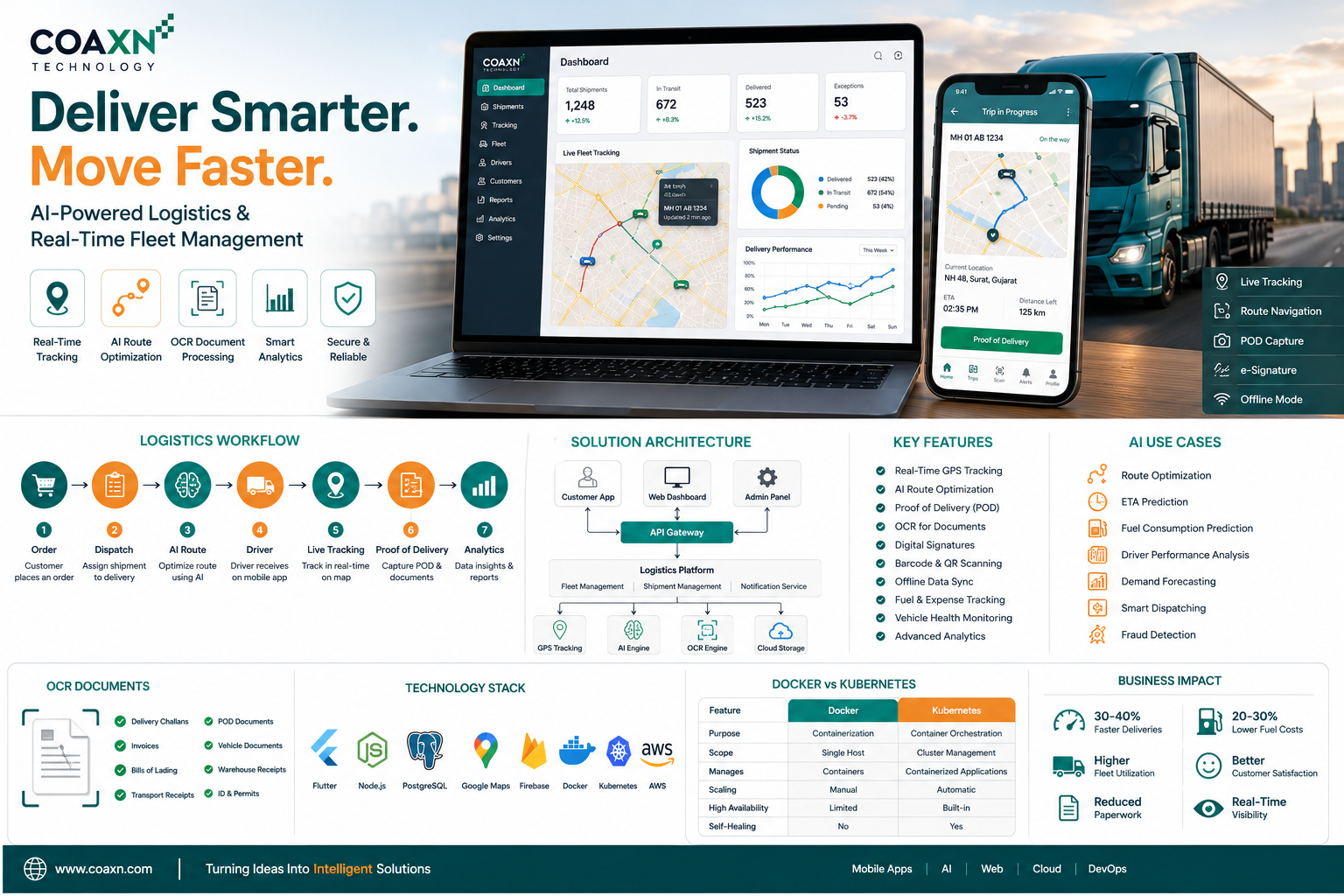
A modern logistics platform integrates mobile applications, cloud infrastructure, GPS tracking, AI-powered analytics, and OCR technologies into one centralized ecosystem.
System Architecture
Customer App
      │
      ▼
API Gateway
      │
      ▼
Logistics Management System
      │
 ┌──────────────┬──────────────┬──────────────┐
 ▼              ▼              ▼
GPS Tracking   AI Engine      OCR Engine
      │
      ▼
Driver Mobile App
Driver Mobile Application Features
- Live GPS tracking
- Google Maps navigation
- Route optimization
- Barcode & QR code scanning
- Digital proof of delivery
- Photo capture
- Digital signature
- Offline synchronization
- Vehicle inspection checklist
- Fuel expense reporting
- Push notifications
Customer Mobile Application Features
- Real-time shipment tracking
- Estimated delivery time (ETA)
- Push notifications
- Order history
- Delivery status updates
- Digital invoices
- Customer support
- Feedback and ratings
Admin Dashboard
- Fleet monitoring
- Vehicle management
- Driver management
- Shipment tracking
- Warehouse overview
- Performance analytics
- Fuel consumption reports
- Business intelligence dashboard
Artificial Intelligence in Logistics
AI enables logistics companies to make smarter decisions using real-time data and predictive analytics.
Common AI Use Cases
- Route optimization
- Delivery ETA prediction
- Driver performance analysis
- Fuel consumption prediction
- Demand forecasting
- Warehouse optimization
- Smart shipment allocation
- Fraud detection
OCR-Based Document Processing
Optical Character Recognition (OCR) eliminates manual data entry by automatically extracting information from logistics documents.
Supported Documents
- Delivery Challans
- Invoices
- Bills of Lading
- Transport Receipts
- Vehicle Documents
- Proof of Delivery (POD)
- Warehouse Receipts
Google Maps Integration
- Live vehicle tracking
- Turn-by-turn navigation
- Traffic-aware routing
- Geofencing
- Distance Matrix API
- Multiple delivery stops
- Location history
- ETA calculation
Technology Stack
| Layer | Technology |
|---|---|
| Mobile App | Flutter |
| Backend | Node.js |
| Database | PostgreSQL |
| Maps | Google Maps Platform |
| Notifications | Firebase Cloud Messaging |
| AI Services | Python & Machine Learning |
| Document Processing | OCR Engine |
| Infrastructure | Docker & Kubernetes |
| Cloud | AWS |
Business Benefits
- 30–40% faster deliveries
- Reduced fuel costs
- Higher fleet utilization
- Improved customer satisfaction
- Lower operational costs
- Reduced paperwork
- Better shipment visibility
- Accurate delivery tracking
- Improved driver productivity
- Real-time business insights
Real-World Logistics Workflow
- Customer places an order.
- Order is assigned to the logistics platform.
- AI calculates the optimal delivery route.
- Driver receives the trip on the Flutter mobile app.
- Vehicle location is tracked in real time using GPS.
- Customer receives live tracking updates.
- Proof of delivery is captured using digital signature and photo.
- OCR extracts information from delivery documents.
- Analytics dashboard updates business reports automatically.
How CoAxn Technology Can Help
At CoAxn Technology, we build intelligent logistics software solutions that combine Flutter mobile applications, AI-powered analytics, OCR automation, Google Maps integration, cloud infrastructure, and enterprise dashboards.
Whether you're managing a fleet of 20 vehicles or thousands of daily shipments, our scalable logistics solutions help improve operational efficiency, reduce costs, and deliver an exceptional customer experience.
Conclusion
The future of logistics is driven by intelligent automation. Businesses that embrace AI, mobile applications, GPS tracking, OCR, and cloud technologies gain a significant competitive advantage through faster deliveries, better visibility, and smarter decision-making.
If you're planning to digitize your logistics operations, CoAxn Technology can help you build secure, scalable, and future-ready logistics solutions tailored to your business needs.